


Continue shopping
Have an account?
Log in to check out faster.

In the mid-2010s, when Twitter was hitting its stride, an aspiring artist named Lizzie Grant posted a bathroom mirror selfie with her Blackberry. The phone was bedecked in rhinestones and jewels, and yet, the subject herself was still the focal point. Lizzie’s skin was smooth, lips plump, hair a bleached, beachy blonde. Whether or not it was an accurate representation of the singer, later known as Lana Del Rey, she was picture perfect.

For years, the Blackberry was beloved for this reason. While capable of Internet access and rudimentary navigation, it’s real claim to fame was the camera (celebrities like Kim Kardashian and Paris Hilton made good use of that specific function). The result was a little grainy, sepia-saturated and out of focus, but just about everyone looked good. Recently, a girl posted who mother’s Blackberry photos from her time as a fashion editor. They immediately went viral
Of course, the Blackberry was blown out of commission by touch screen alternatives. Officially discontinued in TKT, it disappeared from view — not for Kim K’s lack of trying. In it’s stead, we have cameras that record in 60 frames per second in 4k, boast night mode, auto focus and 40 times zoom. With each new iPhone, the camera improves, clearer and more responsive than ever. What we have now is undoubtedly better, so, why are we craving the Blackberry?

This year Tyla chronicled her everyday essentials for GQ. Among them was both a classic Blackberry and iPhone 5C (the one with a home button that you need a finger to unlock). She argued each phone’s camera is much more flattering than newer, HD devices.
“The only function is for pictures,” she says. “These add a soft blur, your makeup blends nice.”
One of Tyla’s team members is tasked with transferring the photos to her other phone — an updated iPhone — which she uses for everything else. This is apparently an arduous experience, especially for the Blackberry, which requires texting each individual image to a Samsung, and then an Apple phone, one by one.
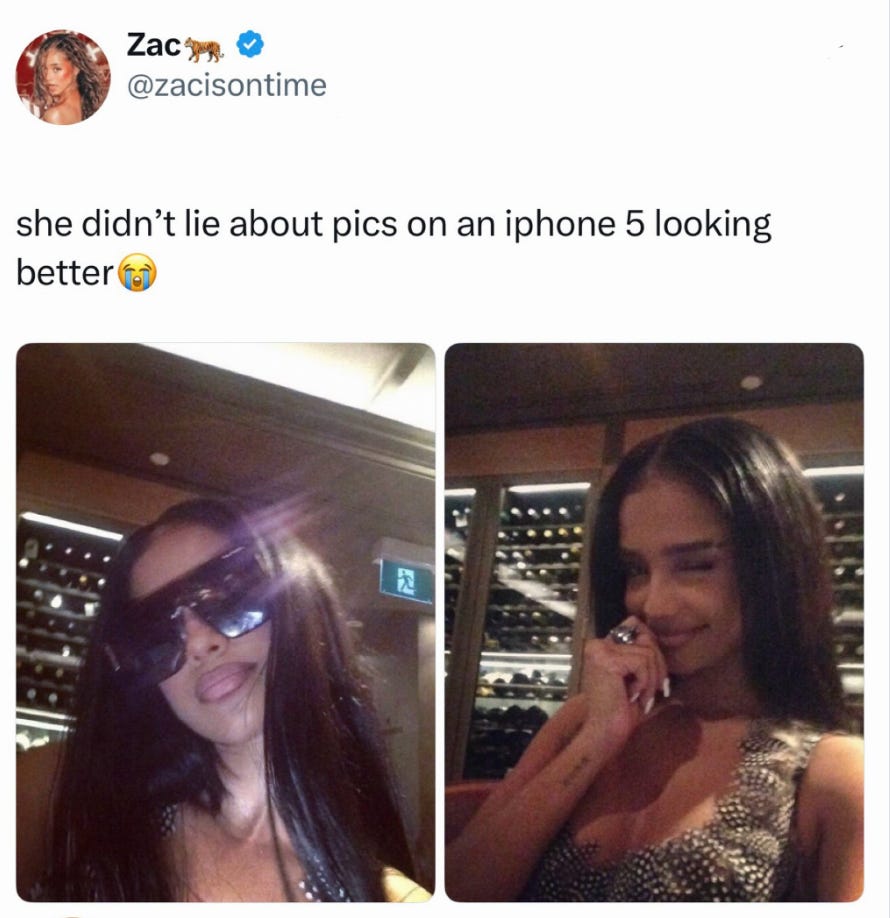
Since Apple monopolized the industry with planned obsolescence (a strategy where old products date themselves), consumers have compliantly purchased each new model. Now, our every pore is routinely documented in 4k. An affinity for Blackberry and old iPhone photos is a clear evolution of the #shoton35mm Tumblr trend in the early 2010s, which gave way to the digital camera craze — when trendsetters sourcing ‘vintage’ digital cameras en masse drove up the price of pink 2005 Fujifilms on resell sites. Whereas poor camera quality were once derided as a sign of unsophistication, as in, clearly you are too broke to keep up with technology, hazy images are now only accessible to few. And just like that, they become a symbol of taste.

This sense of exclusivity also extends into other cultural mediums. For the past two years, vinyl stores and in-person book sales have flourished — defying improbably odds. Online, ‘it’ girls regularly post old iPods. There was a time when it felt radical to both take a photo and listen to a song with your phone — a clear upgrade in convenience compared to carrying four separate devices. There’s even a trend where girls aesthetically stage their iPod next to a Nokia 2280 cellphone, digital camera and USB drive, then upload a snap with the caption, “technology should’ve stopped here.” Those photos were likely taken with a new-edition iPhone. Recently, a friend in France told me that she is communicating with an Australia-based guy exclusively via written letter. They won’t speak on Instagram or any other platform, and it takes around a month after she sends a letter to receive a reply. In her last delivery, he sent her a mixed cassette tape with the instruction to “figure it out.” It’s legitimately husband-is-away-at-war stuff.
Every generation has a tendency to romanticize the past. Older people harken back to ‘A Simpler Time’ and the ‘Good Old Days’ — usually a time before they were forced to shoulder the responsibilities of adulthood — while younger people embrace the velocity of progress, head on. It would be easy to chalk up the lo-fi movement to vanity, exclusivity or run-of-the-mill nostalgia, but when the youngest among us are outright rejecting tech advancement — pining, even, for an era they never even experienced — it seems like a plea to keep things from going too far.
Obviously, in the midst of AI whistleblowing, it’s easy to understand why we might regress to analog. When everything is easy, instant, perfect, life loses meaning. Now, we not only want friction, we’re seeking it out. That may look like six different devices, a vinyl player, sourcing a cassette player for a long-distance lover, or connecting your camera via cord to download your vacation photos — at least your skin will look smoother. Sometimes (rarely) regression is good, and we should expect to see a lot more of it.
Leave a comment
Your email address will not be published. Request fields are marked*